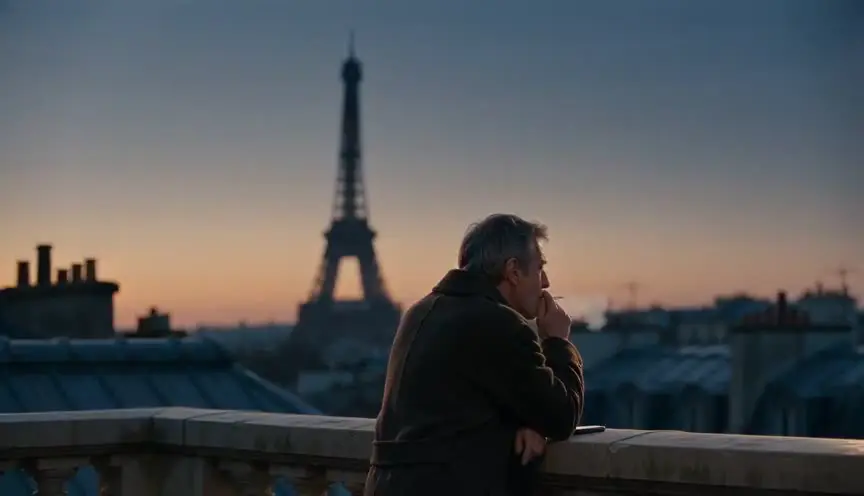
He's had four drinks. Maybe five. The scene requires him to be drunk, not sloppy, not cartoonish, but genuinely impaired. Somewhere between buzzed and blackout. And you, the writer, have to indicate this on the page with enough specificity that the performance feels grounded, not guesswork.
The challenge: "He's drunk" isn't enough. It tells the actor nothing about how to play it, leaving them to fill in blanks that should already be shaped by your intent. And overwriting, "He sways, slurs every word, nearly falls", turns the character into a caricature, stripping away the nuance that separates believable intoxication from stock behavior. Real intoxication is subtle, specific, and often more sad than funny, demanding a writer's eye for behavioral detail rather than broad strokes.
This guide covers how to write drunk characters with precision: using stage directions that guide performance without dictating it, offering actors and directors a clear emotional and physical anchor while preserving their interpretive freedom.
Cinematic workflow frames

These two visuals work as a pair: the first shows Cinematic workflow still, first angle, 35mm film grain, and the second shifts to Cinematic workflow still, second angle, 35mm film grain - compare them briefly to see how framing and perspective reveal different layers of a character's intoxicated state, then move on.

The Problem with "He's Drunk"
If you write:
Michael enters. He's drunk.
The actor and director make all the choices. What kind of drunk? Happy? Angry? Sloppy? Functional? The reader has no idea what the scene should look like, which means the page has failed to establish the emotional or behavioral baseline the scene depends on.
If you overwrite:
Michael enters the space. The signs are unmistakable and layered: his gait is unsteady, his speech loses its crispness and precision, his gaze fails to lock onto anything specific, he reaches out to brace himself against chairs and tables as he moves, involuntary sounds escape his throat, and his foot catches on the edge of the rug, nearly sending him down.
At this point you've crossed into micromanagement territory, dictating every beat of the performance. The result is an actor who feels hemmed in, unable to bring their own interpretive choices to the role. What you've written may read as earnest drama on the page, but on screen or stage it risks tipping into unintended comedic territory, no matter what tone you were aiming for.
What you're aiming for lives in the middle ground: offering enough direction to shape the moment without turning it into a rigid checklist. The sweet spot is guidance that leaves room for interpretation, not a dictatorship that eliminates creative agency.
Principle #1: Choose the Type of Drunk
Intoxication doesn't express itself in a single universal template. Its outward signs shift depending on the individual's constitution, the specific substance involved, the dosage, and the surrounding circumstances. As a writer, your first task is to identify which variant of intoxication your particular scene calls for:
The Functional Drunk. On the surface, this character appears nearly sober, maintaining a veneer of composure. The cracks only show in subtle details: they enunciate each word with exaggerated precision, their physical movements become unnaturally measured and controlled, and their conversational responses arrive a fraction of a second later than they should, as if processing through a slight fog.
The Happy Drunk. Loose, warm, affectionate. Laughs too easily. Says things they normally wouldn't.
The Sad Drunk. Maudlin. Emotional dam breaks. Years of repressed feeling surface.
The Angry Drunk. Short fuse. Reads offense in everything. Violence simmers.
The Sloppy Drunk. Loss of motor control. Stumbling. Slurring. The stereotypical "drunk" but real for some people.
The Blackout Drunk. Functioning on autopilot. May not remember this conversation tomorrow.
Your stage directions should paint the behavioral texture—how the character moves, speaks, and reacts—in enough sensory detail that the category reveals itself without ever being labeled outright.
A Table: Types of Drunk and Their Tells
| Type | Physical Tells | Speech Tells | Emotional Tells |
|---|---|---|---|
| Functional | Deliberate movements with exaggerated care, as though measuring each gesture; occasionally reaching for objects with unnatural precision | Speech remains precise in structure but tempo drags; words are chosen carefully yet the wrong synonym may slip through; pauses lengthen between thoughts | Affect stays controlled and slightly mechanical, emotional responses arrive a beat late or land just adjacent to the expected tone |
| Happy | Limbs swing freely with expansive, open gestures; posture lifts and opens; movements flow without constraint, often spilling into the space of others in a warm, non-threatening way | Voice rises in volume and pitch, tempo accelerates, sentences branch into spontaneous tangents and anecdotes; laughter punctuates speech frequently | Tone becomes affectionate and unguarded, physical touch comes easily, inhibitions drop away, joy radiates outward without self-monitoring |
| Sad | Shoulders curl inward, spine slumps as though bearing invisible weight; gaze drifts unfocused toward middle distance or downward; movements become slow and effortful, hands may cover face or fidget aimlessly | Volume drops to near-whisper, sentences trail into silence before completion, confessional admissions emerge unprompted; rhythm becomes halting and uneven | Vulnerability opens wide, tears may well up or fall freely, emotional defenses collapse, responses feel raw and unfiltered |
| Angry | Muscles tense visibly, jaw clenches, body leans forward into others' personal space as though claiming territory; gestures become sharp and abrupt, fists may form | Speech turns cutting and harsh, same accusations or grievances loop repeatedly with rising intensity, blame is assigned directly and without cushioning | Mood swings volatile and hair-trigger, reactions flare disproportionately to stimuli, patience evaporates, every word carries an edge |
| Sloppy | Swaying, gripping surfaces | Slurred, incomplete sentences | Variable, unpredictable |
| Blackout | Mechanical, robotic | Repetitive, disoriented | Vacant, disconnected |
Technique #1: The Specific Physical Detail
Rather than "drunk," give one or two specific physical tells:
Example:
Michael enters. He closes the door with extra care, the precision of someone trying hard not to make noise.
This implies intoxication without naming it. The actor understands: functional drunk.
Example:
Sarah sits at the bar. Her laugh is too loud, and when she reaches for her glass, she knocks over the cocktail napkin. She doesn't notice.
Small, specific. Happy drunk, losing fine motor control.
Example:
Tom stands at the window. His posture is slack. He speaks to his reflection more than to her.
Sad drunk. Turned inward. Not performing for the room.
Technique #2: The Speech Pattern
Intoxication affects speech. You can indicate this in action description or through dialogue formatting:
Slurred speech:
MICHAEL (words slightly loose) I told him. I told him everything.
The parenthetical suggests slurring without phonetic spelling ("I tol' him"). Phonetic spelling can feel insulting; let the actor interpret.
Over-precise speech:
SARAH (enunciating carefully) I am perfectly. Capable. Of driving myself home.
The periods indicate deliberate pacing—a technique where punctuation mirrors the character's effortful articulation as they try to mask impairment and project control.
Trailing off:
TOM It doesn't matter anymore. It never... (loses the thought) What was I saying?
The unfinished sentence paired with the action description reveals mental fog and disorientation, capturing how cognitive function deteriorates under intoxication.
Technique #3: The Behavioral Moment
One key action—whether a stumble, a slurred word, or a lapse in thought—can convey intoxication with more authenticity and impact than layering multiple overt indicators.
Example:
Michael reaches for his keys. Misses. Tries again.
Simple. Concrete. Drunk.
Example:
Sarah hugs him, longer than she normally would. She doesn't want to let go.
Emotional inhibition lowered. She's not sloppy; she's exposed.
Example:
Tom laughs at nothing. Then stops. His face goes dark.
Volatile. The emotional weather is shifting.

Try it free
Try 熙熙 for free on your script
It is free. Import your existing project, get a clearer view of your outline, and regain control of your story structure in minutes.
Start FreeThe "Trench Warfare" Section: What Goes Wrong
Failure Mode #1: Caricature
The drunk character is a sitcom joke: hiccupping, lampshade-on-head, can't walk straight.
How to Fix It: Ground the intoxication in reality. Watch documentaries or interviews with intoxicated people. Notice the subtlety. Even very drunk people often think they're behaving normally.
Failure Mode #2: Only Physical, No Emotional
The script shows motor impairment but ignores how alcohol affects emotion and judgment.
How to Fix It: Drunkenness operates on two planes simultaneously—the physical and the psychological. What inhibitions dissolve when alcohol floods the system? What buried feelings or suppressed truths claw their way to the surface? Write the complete emotional shift and internal transformation, not merely the external stumble or slurred consonant. Show how the character's inner landscape warps under intoxication.
Failure Mode #3: Phonetic Spelling
Dialogue written as: "I shwear, I didn' do nuthin'."
How to Fix It: Avoid phonetic spelling. It's hard to read and can feel condescending. Use parentheticals or action description to indicate slurred speech; let the actor perform it.
Failure Mode #4: Inconsistent Intoxication
The character staggers through one line in a state of sloppy, incoherent drunkenness, then delivers the next with perfect articulation and razor-sharp logic, as if sobriety arrived between breaths.
How to Fix It: Track the arc and consistency of intoxication throughout the entire scene. If a character is genuinely impaired at one moment, that impairment must persist and evolve—it doesn't vanish without cause. Brief moments of clarity are possible and can be powerful, but they should register as effortful, hard-won, or fleeting, not as magical resets.
Failure Mode #5: Drunk Without Reason
The character is drunk because the plot mechanically requires it for a specific story beat, but the actual act of drinking is never shown on the page, and no emotional or situational motivation for the intoxication is established.
How to Fix It: Establish the drinking earlier in the narrative, either by showing it on-screen or through character reference and dialogue. Why are they drunk in this moment? What specific event, conflict, or emotional pressure drove them to it? Intoxication functions as a symptom of deeper character state; the underlying cause and context matter for the scene to land with weight.
Example Scene: Functional Drunk
INT. LIVING ROOM – NIGHT
Michael sits on the couch. A glass of whiskey, mostly empty, rests on the table within arm's reach. Another glass beside it is already drained, the amber residue still clinging to the inside.
Sarah enters, sets down her bag.
SARAH How long have you been home?
MICHAEL (too even) A while.
He reaches for the glass. His hand is steady when it moves, but the movement itself is deliberate and measured, the kind of controlled motion that belongs to someone working consciously not to wobble or tip.
SARAH You've been drinking.
MICHAEL I had a drink.
He smiles at something unsaid. The smile is just slightly off—too wide at the edges, held a fraction too long, not quite matching the moment.
SARAH Michael.
MICHAEL (the facade cracking) I'm fine. I'm always fine.
This scene conveys intoxication through layered storytelling choices: the visual setup of drinking evidence (multiple glasses), physical control that hints at effort (deliberate movement to mask impairment), speech patterns that are too even and measured, and behavioral tells like the cracking smile that doesn't align naturally. No phonetic spelling of slurred words, no slapstick stumbling or exaggerated comedy.
Writing Drunk Dialogue
Drunk people don't always slur. They might:
- Repeat themselves
- Lose their train of thought
- Say things they'd never say sober
- Become fixated on one idea
- Confess
- Contradict themselves in the same sentence
Example:
TOM I never loved her. I loved her so much. You know what I mean? You know.
The contradiction is drunken logic. It makes emotional sense even when it makes no literal sense.

The Perspective: Writing the Unseen
Intoxication is an internal state with external symptoms. Your job is to write the symptoms, the tells, in a way that suggests the internal reality.
This is true for many states: fear, grief, love, exhaustion. You can't film the feeling; you can only film the behavior. But the behavior must be chosen carefully, or it rings false.
For drunk scenes, the key is specificity. Not "drunk" but "reaching for keys and missing." Not "slurred" but "enunciating carefully, like each word is a test." Not "emotional" but "laughs at nothing, then stops, face going dark."
These details guide the actor without trapping them in a single interpretation. They give the reader a movie to see in their mind—specific, visual, grounded. And they keep the scene anchored in human behavior, not cartoon exaggeration or cliché.
Write the drunk you've actually seen at a wedding, a bar, a friend's kitchen. Write the drunk you've been, if you've been there. Write the specific physical details—the loose hinge in the jaw, the too-careful enunciation, the way someone steadies themselves on a counter. That's how it rings true and earns the audience's belief.
[YOUTUBE VIDEO: An acting coach discussing techniques for playing intoxicated characters, with examples of subtle vs. over-the-top performances and what the script can do to guide actors.]
Further reading:
- For internal states in action lines, see the unfilmable action line: writing what can't be seen on screen.
- If you're writing emotional transformations, see the before/after scene: showing character status change without dialogue.
- StudioBinder has resources on directing actors through physical states at studiobinder.com{:rel="nofollow"}.
Final Step
Build your next script with 熙熙
Move from ideas to production-ready pages faster with timeline-native writing and AI-assisted story flow.
Try 熙熙