Comic to Animation Calculator
How long your comic, manga or graphic novel runs as animation
Enter the page count and panel density of a comic, manga, album or graphic novel and this comic to animation calculator returns the shot count, the runtime you can expect, an episode split tailored to the format you target, plus the exact number of board frames and clips an AI pipeline would need to generate to bring it to life.
A comic page is not a minute of screen time and a panel is not a shot. Action panels drawn mid-movement hide a before and an after and become two or three shots when animated; three talking-head panels in the same framing are one continuous shot with three lines of dialogue; and every scene needs an establishing shot the page never drew because comics skip it. The calculator applies those three structural corrections to your input, then converts the resulting shot breakdown to accurate time.
Everything runs in your browser. Nothing you enter is sent anywhere or stored.
sets set the page count and panel density automatically. Edit either number directly for your own book's specifics.
Flip through the book once and estimate. Recalibrate after boarding one chapter.
Adaptation size
| Scenes and establishing shots | 本项目共包含 7 scenes 场景段落,并为每个场景配置了 7 establishing shots 建立镜头,用于交代空间环境与叙事转场。 |
| Screen time per page | 24.2 s |
| Per episode | Whole book in one film |
| Storyboard frames | 152 frames, one per shot |
| AI generation load | AI 生成工作量为 152 clips 素材片段,按每个镜头平均 3 tries per shot 的迭代次数计算,总计约 456 generations 生成任务。 |
Take the clip count 将上述 clip count 片段数量输入到 AI video cost calculator 成本计算器,选择你使用的 AI model 模型,即可将生成量转换为具体的 budget 预算金额。
How the calculator counts
Pages times panels per page gives the panel count. The action share of those panels is multiplied by 2.5, because a panel drawn mid-movement becomes a wind-up, an impact and a result. The merge share is divided by three, because same-framing dialogue panels of one speaker are a single shot with several lines. The rest count one for one. One establishing shot is added per scene at roughly a scene every three pages. Shots times seconds per shot gives the runtime; the runtime divided by the target episode length gives the episode count, and the pages per episode tell you where the breaks fall in the book. The generation load is one board frame and one clip per shot, with three generations per shot as the typical retry rate.
Why page count is the wrong way to size an adaptation
Writers size a screenplay by pages because a screenplay page was designed to be a minute. A comic page was designed to be read at whatever speed the reader chooses, and its panels were composed to be looked at, not to last. Two books with the same page count can be a nine-minute short and a forty-minute film, and the difference is entirely in how many panels are action, how many are conversation, and how many scenes there are.
Those three numbers are what the calculator asks for, and they are the three decisions a storyboard artist makes on every page: split this, merge these, add an establishing shot here. The runtime is a consequence of them, not of the page count.
For an AI-produced adaptation the same three numbers are the budget. Every shot is a board frame and a clip, and every clip gets generated about three times before one survives the edit. Sizing the book first is the difference between a plan and a surprise.
For the panel-by-panel method behind the ratios, read comic panels to storyboard and its worked page.
Who uses the comic to animation calculator
- Comic creators. Size an issue or an album before pitching it as a short, a series or a film.
- Manga adapters. Split a tankobon into 22-minute episodes and see how many chapters each one eats.
- AI filmmakers. Turn a book into a clip count and a retry budget before the first generation.
Start from the screenplay.Get the storyboard.
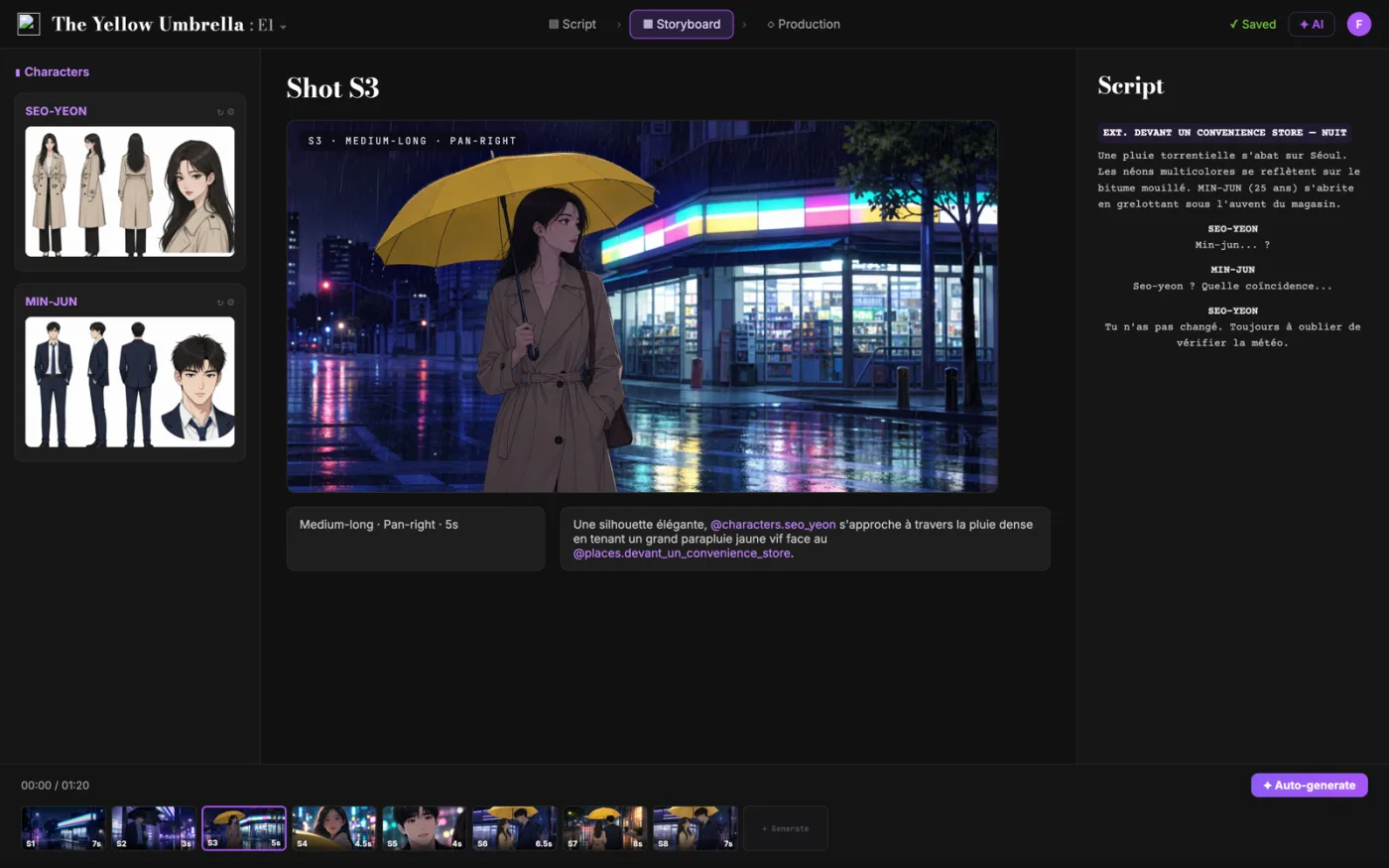
熙熙 breaks your script into shots and generates the storyboard from it. You control framing, angle, movement and duration. Characters carry from shot to shot.
- 免费, does not expire
- PDF and Final Draft export
- Mac, Windows, Linux, iPad
Comic to Animation Calculator: the complete guide
It multiplies your total pages by the average panels per page, then splits action-heavy panels into multiple shots for dynamic coverage, merges dialogue panels that share the same framing into single shots to maintain continuity, inserts one establishing shot per scene using a heuristic of roughly one scene per three pages, converts the resulting shot list into runtime by applying your specified seconds-per-shot average, divides that runtime into episodes matching your target episode length, and finally reports the total storyboard frames, video clips, and AI generations required assuming a typical three-tries-per-shot retry rate for production planning.
For this workflow, the central problem is immediately clear: a comic page does not equal a minute of screen time and a single panel does not equal a shot, which means adaptation runtimes estimated purely from page count end up wrong by a factor of two in either direction depending on the source material's density. Left unresolved, this mismatch creates downstream friction in scheduling, budgeting, and slower creative decisions across the production pipeline. The practical target output is a reliable shot count, an accurate runtime estimate, a sensible episode split structure, and precise counts of storyboard frames and video clips an AI-driven pipeline would actually need to generate, all derived from your input page count, panel density average, and three key editorial ratios that define how panels map to shots.
Limitation to keep in mind: The action ratio, merge ratio, and scene density are averages calculated over a whole book's structure, not a granular reading of your specific pages panel-by-panel: a fight-heavy issue with dense action choreography can easily double its shot count compared to the average, while a dialogue-driven or exposition-heavy chapter can halve it due to fewer camera cuts and longer held frames. Use the calculator result to size the overall project scope, pick an appropriate format and episode structure, then storyboard the first chapter for real with actual shot breakdowns and recalibrate the three ratios against that concrete first-chapter data to refine your estimates for the remaining material.
Advanced workflow: Advanced users run the calculator separately per chapter using different action ratios and merge ratios tailored to each chapter's pacing and content density, sum the resulting runtimes across all chapters to get the full series runtime, then use the calculated per-episode page count to make informed decisions about exactly where episode breaks should fall on the page to match narrative beats, and finally paste the generated episode list directly as the structural outline of a 熙熙 project so they can board each individual chapter in the target aspect ratio with proper episode boundaries already defined.
Step-by-Step Workflow
- Pick the format preset closest to the book (US issue, album, tankobon, graphic novel) or type the page count and panel density by hand.
- Set the action share (panels drawn mid-movement that hide a before and after) and the merge share (same-framing dialogue panels) from a quick flip through the book.
- Choose seconds per shot: 2.5 to 3 for action and vertical, 3.5 to 4 for drama, 5 for slow graphic novel pacing.
- Pick the delivery target (film, 90 second vertical, 5 minute short, 11 or 22 minute episodes) and read the episode split, then copy the summary into your pitch or plan.
Use Cases By Profile
- Comic creator: find out whether a 22-page issue is a 90-second teaser or a nine-minute short before boarding a single panel.
- Manga adapter: size a tankobon into 22-minute episodes and see how many chapters each episode consumes.
- AI filmmaker: turn a graphic novel into a clip count and a retry budget before spending credits.
Common Mistakes To Avoid
- Assuming one panel equals one shot, which undercounts fights and overcounts conversations.
- Forgetting establishing shots: the page told the reader where they were, the cut does not.
- Boarding the whole book before sizing it, then discovering the film is forty minutes and the budget was for nine.
Professional Best Practices
- Board one chapter first, count the real shots, and set the ratios so the calculator matches it before sizing the rest of the book.
- For a vertical release, set 2.5 seconds per shot and 90 second episodes and expect one issue to make three to five episodes.
- Use the per-page seconds figure as the sanity check: under 15 seconds a page means you are skipping panels, over 45 means you are animating every one.
Treat this tool output as a decision support layer that informs your process, not a replacement for authorship or creative judgment. Great scripts are remembered for specific choices, emotional precision, and clarity of dramatic movement that only human intent can shape. Tools help by removing noise, handling mechanical calculations, and surfacing structural patterns so your creative energy can go where it truly matters: character development, conflict architecture, escalation pacing, and narrative payoff. If you review outcomes carefully after each calculator pass and keep an explicit log of accepted changes with notes on why certain ratios or splits worked better than others, your workflow becomes faster and more predictable from draft to draft, building institutional knowledge. That consistency is exactly what professional collaborators value most: fewer surprises mid-production, clearer rationale behind structural decisions, and a script that evolves with visible intent rather than trial and error.
Extended FAQ
How long is a comic book as an animation?
A typical 22-page US issue at five to six panels a page comes out around 150 shots and eight to nine minutes at 3.5 seconds a shot, once action panels are split, dialogue panels merged and establishing shots added. A 48-page album runs 20 to 25 minutes, a 190-page tankobon about 90 minutes.
How many manga chapters make one anime episode?
At 18 to 20 pages a chapter and roughly 25 seconds of screen time per page, a 22-minute episode covers two to three chapters. The calculator gives the exact split for your page count and panel density; the pages-per-episode figure is where the episode breaks fall.
Why is a panel not a shot?
An action panel drawn mid-movement hides a before and an after, so it becomes two or three shots. Three talking-head panels of the same character in the same framing are one shot with three lines. And every scene needs an establishing shot the page never drew, because a page turn told the reader where they were and a cut does not.
Does the calculator work for manga and bande dessinee?
Yes. The manga preset uses 192 pages at five panels a page, the album preset 48 pages at nine; both are editable. Right-to-left reading order does not change the count, and dense Franco-Belgian pages mostly raise the merge share, since more of the panels are same-framing dialogue.
What does the AI generation load line mean?
One storyboard frame per shot, one clip per shot, and three generations per shot at a typical retry rate. Feed the clip count into the AI video cost calculator with your model to get a budget; the retry multiplier is what decides it.
Comic to animation calculator FAQ
A 22-page issue at five to six panels a page lands around 150 shots and eight to nine minutes at 3.5 seconds a shot. A 48-page album is 20 to 25 minutes, a 192-page tankobon about 90 minutes. The ratios matter more than the pages: a fight-heavy issue can double the count.
Two to three chapters of 18 to 20 pages per 22-minute episode, at roughly 25 seconds of screen time per page. The calculator gives your exact split; the pages-per-episode figure is where the breaks fall.
Because the page told the reader where they were and a cut does not. Comics open scenes on a face constantly, since the previous scene ended a page turn ago. Animation needs a wide shot the artist never drew, about one per scene.
2.5 to 3 for action or a vertical release, 3.5 to 4 for drama, 5 for a slow graphic novel. The average shot length of the animation you want to resemble is the right number, and most anime sits between 3 and 4.
Yes. Paste the episode split as the outline, write the shot list as a script, attach the characters as story elements with reference sheets cut from the book, and the storyboard generates a frame per shot in 16:9 or 9:16. The clip count from this calculator is what the production side then generates.
Related tools
Storyboard Template Generator
Create printable storyboard sheets in any aspect ratio.
AI Video Cost Calculator
Budget an AI film per finished minute, retries included.
Scene to Clip Splitter
Split a scene into AI video clips that fit your model's duration cap.
Script Time Calculator
Estimate runtime from screenplay pages or pasted script text.
You can also browse the full library on /tools.
Core blog guides
- Idea → first draft (process hub)
- Screenplay format guide 2026
- Hidden costs of “free” software
- Affordable software & TCO
- Revision passes (structure → dialogue)
Film techniques
Film techniques to explore
Each one with a short clip, a screenplay excerpt and the shot list line.