Echo Finder
Repetition checker · Word echo finder for scripts
Writers all have "tic" words they repeat without noticing,the same verb, noun, or adjective showing up again and again in a scene.
Paste your scene text below. The tool ignores function words (the, a, and, but, etc.) and highlights content words (verbs, nouns, adjectives) that appear more than three times close together so you can spot echoes and vary your wording.
Runs entirely in your browser. A small script counts word frequency and the distance between occurrences; only words that repeat at least four times with at least one pair of occurrences within 50 words are flagged.
How it works
The algorithm tokenizes your text and filters out stopwords (articles, conjunctions, pronouns, common auxiliaries). For each remaining word it records every position. A word is flagged as an "echo" if it appears at least four times and at least two of those occurrences are within 50 words of each other. Highlighting is done in your browser; no data is sent to any server.
You timed the pages.Now write the rest.
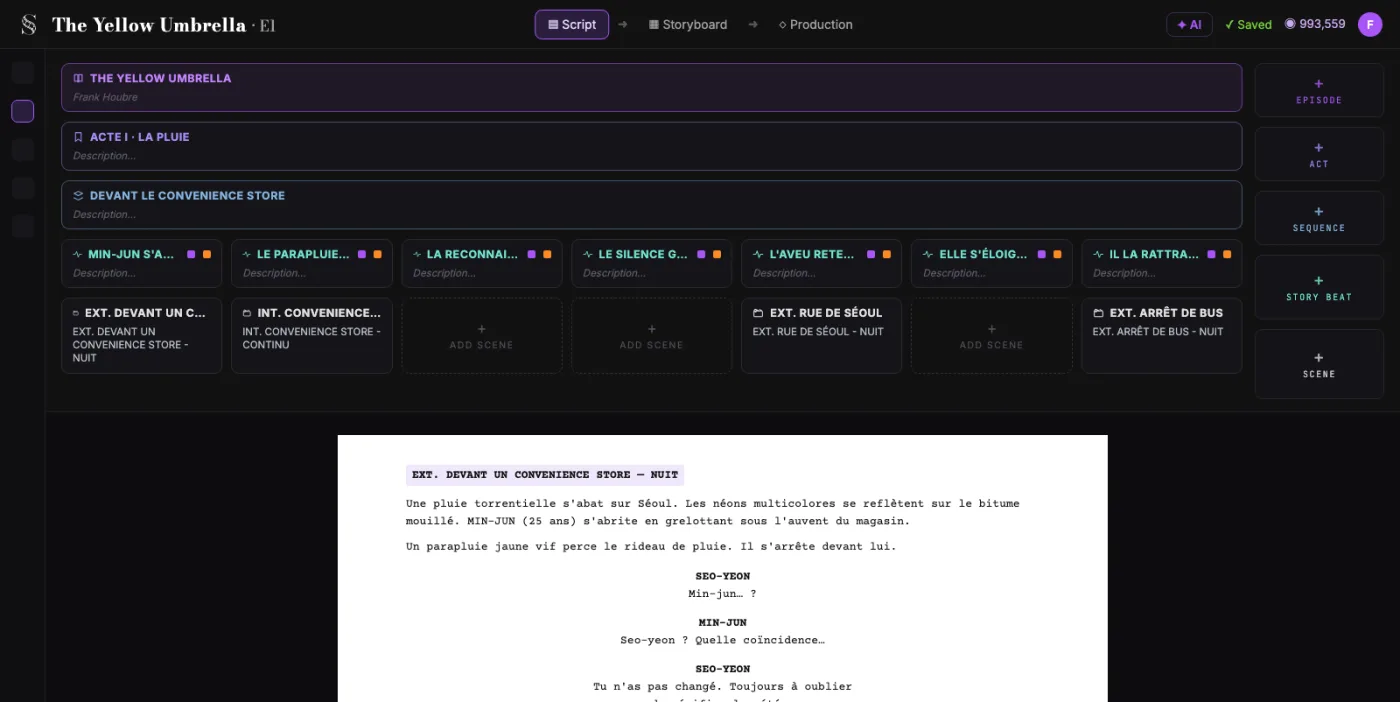
Write the whole screenplay in 熙熙, with industry-standard formatting and unlimited pages. The 免费档 is free and does not expire.
- 免费, does not expire
- PDF and Final Draft export
- Mac, Windows, Linux, iPad
Echo Finder: the complete guide
It finds repeated high-impact words that cluster too closely, helping prose feel intentional instead of repetitive.
For this workflow, the central challenge is unambiguous: overlooked word repetition can render prose texturally flat, pacing rushed, or tonally unintentionally comedic. When left unaddressed, this issue generates downstream friction—slower decision cycles, muddled authorial intent, and reader fatigue. The practical objective is cleaner linguistic texture paired with stronger sentence-level variety and meaningfully reduced accidental redundancy across paragraphs.
Limitation worth keeping in mind: It cannot automatically distinguish every instance of poetic recurrence or deliberate thematic echo from accidental duplication; human editorial judgment remains required to preserve intentional patterning.
Advanced workflow recommendation: Run echo analysis immediately after structural rewrites, because scene reordering and blocking adjustments often introduce duplicated verbs, emotional labels, and action phrases unintentionally during the revision process.
Step-by-Step Workflow
- Analyze one sequence at a time and inspect clusters of repeated content words.
- Decide whether each repetition is intentional motif or unintentional echo.
- Replace or reframe only the low-value repeats that reduce clarity or tone.
- Run a final pass to confirm voice consistency after substitutions.
Use Cases By Profile
- Writer: clean verbal tics before sharing pages.
- Editor: accelerate polish pass on diction diversity.
- Team rewrite room: standardize tone across multiple contributors.
Common Mistakes To Avoid
- Removing all repetition, including intentional rhetorical effects.
- Replacing words with weaker synonyms just to vary vocabulary.
- Ignoring nearby echoes that degrade line impact.
Professional Best Practices
- Protect intentional motifs while trimming accidental repetition.
- Prioritize high-frequency verbs and adjectives in cleanup passes.
- Read revised sections aloud to catch rhythmic monotony.
Treat this tool output as a decision support layer, not a wholesale replacement for authorship or creative judgment. Great scripts earn lasting recognition for specific word choices, emotional precision, clarity of dramatic movement, and disciplined escalation. Tools help by systematically removing linguistic noise so your creative energy can flow where it genuinely matters: character definition, conflict architecture, escalation design, and payoff execution. If you make it a habit to review outcomes after each processing pass and maintain an explicit log of accepted changes with brief rationale notes, your workflow becomes faster, more repeatable, and more predictable from draft to draft. That consistency is exactly what professional collaborators value most: fewer last-minute surprises, clearer decision rationale, and a script that evolves with visible intent rather than drift.
Extended FAQ
Should all repetition be removed?
No. Preserve intentional motifs, thematic callbacks, and rhetorical echoes that serve dramatic or emotional function. Remove only low-value accidental repetition that adds no meaning or rhythm.
What words should I prioritize in cleanup?
High-frequency verbs, adjectives, and emotional labels that flatten voice when repeated.
Can echo checks change tone accidentally?
Yes if replacements are careless. Always validate revised diction against character voice and genre tone.
How often should I run this tool?
At late rewrite stages and after heavy structural changes that duplicate language patterns.
Is this useful for dialogue-only passes?
Very. Dialogue rewrites often introduce repeated phrasing unconsciously.
What is a good final QA step?
Read revised pages aloud to verify rhythm, precision, and intentional recurrence.