Slugline Formatter
Format screenplay scene headings with consistent INT/EXT patterns.
Stop fixing margins.Formatting is built in.
熙熙 handles industry-standard formatting and exports to PDF and Final Draft (.fdx). Free, with unlimited pages.
- 免费, does not expire
- PDF and Final Draft export
- Mac, Windows, Linux, iPad
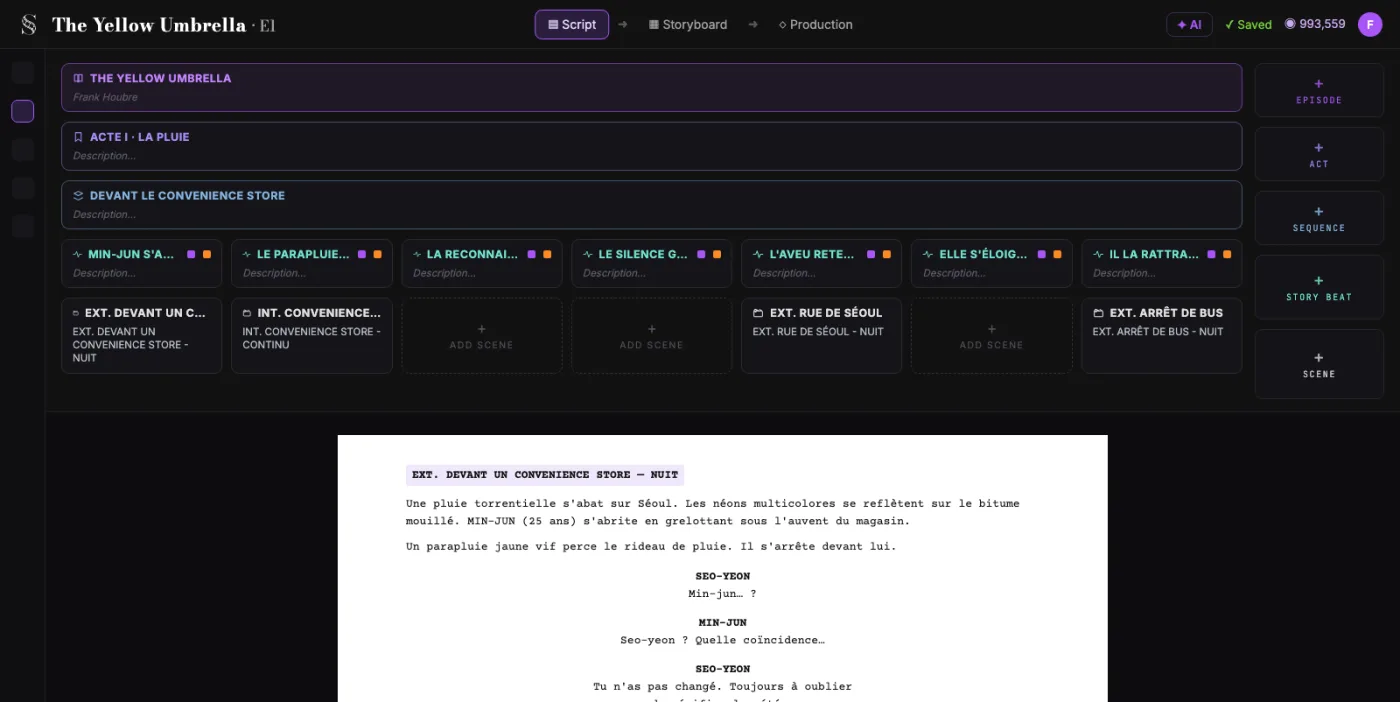
Slugline Formatter: the complete guide
It normalizes scene heading patterns so script navigation and breakdown extraction stay consistent across revisions.
For this workflow, the central problem is clear: inconsistent sluglines create confusion for readers and downstream breakdown workflows. Left unresolved, this creates downstream friction and slower decisions. The practical target is clean, standardized scene headings that improve readability and pre-production reliability.
Limitation to keep in mind: It cannot decide creative geography for you; ambiguous spaces still need writer-level clarity decisions.
Advanced workflow: Use a slugline naming dictionary shared across the project so every draft stays production-parseable. 建立一份场景行命名词典并在整个项目中共享,确保每一稿都能被制片部门准确解析,避免因地点名称不一致导致的拍摄计划混乱。 建立一份场景行命名词典并在整个项目中共享,确保每一稿都能被制片部门准确解析,避免因地点名称不一致导致的拍摄计划混乱。
Step-by-Step Workflow
- Format sluglines consistently with INT./EXT., location, and time-of-day logic.
- Normalize naming conventions to prevent false location splits.
- Audit hybrid spaces (INT/EXT) and transitional headings for clarity.
- Run a final pass before export to keep production docs clean.
Use Cases By Profile
- Writer: keep sluglines uniform during rapid rewrites.
- AD/coordinator: reduce cleanup time before breakdown.
- Production prep: prevent duplicate location buckets from naming drift.
Common Mistakes To Avoid
- Mixing location labels for the same space.
- Inconsistent time-of-day notation.
- Overlong sluglines that bury essential data.
Professional Best Practices
- Create a project slugline style guide early.
- Treat slugline consistency as a production asset.
- Resolve ambiguous locations during outline stage when possible.
Treat this tool output as a decision support layer, not a replacement for authorship. Great scripts are remembered for specific choices, emotional precision, and clarity of dramatic movement. Tools help by removing noise so your energy can go where it matters: character, conflict, escalation, and payoff. 优秀剧本之所以被记住,是因为其中具体的选择、情感的精准度以及戏剧推进的清晰度——工具的作用是过滤噪音,让你的精力集中在真正重要的地方:角色塑造、冲突设计、张力递进和情节回报。If you review outcomes after each pass and keep an explicit log of accepted changes, your workflow becomes faster and more predictable from draft to draft. 如果你在每一轮修改后复盘结果并明确记录接受的改动,工作流程会变得更快且更可预测。That consistency is exactly what professional collaborators value: fewer surprises, clearer rationale, and a script that evolves with intent. 这种一致性正是专业合作者看重的——更少的意外、更清晰的依据,以及一份有意图地演进的剧本。
Extended FAQ
Why do slugline inconsistencies matter so much?
They slow reader navigation and break downstream location grouping for production prep. 它们会拖慢阅读者的浏览速度,并且破坏后期制片准备阶段按地点分组的完整性,导致场景拆分表和拍摄日程安排出现混乱。 它们会拖慢阅读者的浏览速度,并且破坏后期制片准备阶段按地点分组的完整性,导致场景拆分表和拍摄日程安排出现混乱。
What is the minimum slugline standard?
Consistent INT./EXT. marker, stable location naming, and clear time-of-day notation. 保持 INT./EXT. 标记的一致性、地点命名的稳定性以及时间段标注的清晰度,这三项是场景行规范的核心要素,直接影响剧本在制片流程中的可读性与执行效率。 保持 INT./EXT. 标记的一致性、地点命名的稳定性以及时间段标注的清晰度,这三项是场景行规范的核心要素,直接影响剧本在制片流程中的可读性与执行效率。
How do I handle repeated locations?
Use one canonical label per space and avoid stylistic variants unless location truly changes. 为每个空间使用唯一的标准标签,避免出于文体变化而使用不同叫法,除非拍摄地点确实发生了实质性改变——这能防止制片部门误判场景数量和转场成本。 为每个空间使用唯一的标准标签,避免出于文体变化而使用不同叫法,除非拍摄地点确实发生了实质性改变——这能防止制片部门误判场景数量和转场成本。
Should I include CONTINUOUS/LATER everywhere?
Only when it adds practical clarity; overuse creates noise.
Can slugline formatting improve schedule prep?
Yes. Consistency directly improves extraction, grouping, and logistics planning quality.
When should I run final slugline QA?
Before export and before any handoff to production-facing collaborators.
FAQ
Yes, it helps maintain consistent scene heading formatting.
No.
Copy any generated slugline.
No.